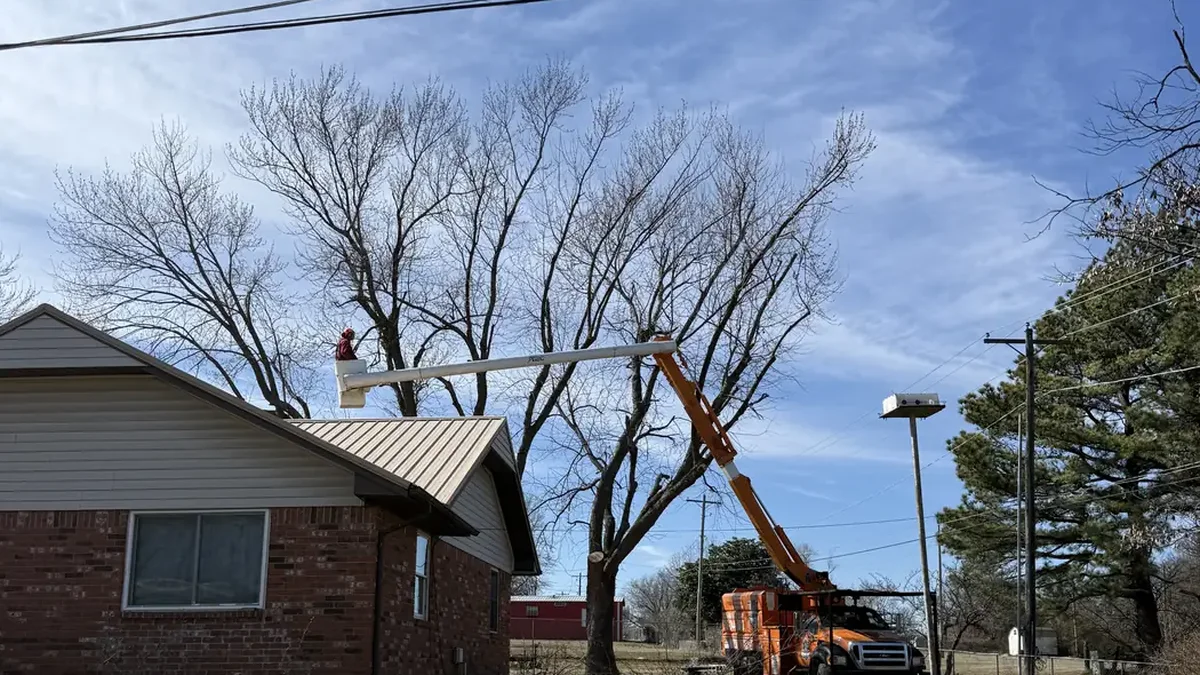
Oklahoma storm season is no joke. Straight-line winds from severe thunderstorms, derechos moving through the state, and the occasional tornado leave trees down across the Tulsa metro every spring. If you’ve found yourself reading this because a tree is currently on your house — here’s what to do, in order.
Step 1: Get Everyone Out and Stay Out
Your first priority is safety. A tree that has partially fallen onto a structure is under stress — it may shift, crack further, or the structure beneath may give way. Keep everyone (including pets) out of any room the tree is contacting.
Do not go on the roof to assess damage. Do not push on the tree or try to move it yourself.
Step 2: Check for Utility Hazards
If the fallen tree has taken down power lines with it — or if you see sparking, smell burning, or your power is out — call PSO (918-599-2055) or AEP/SWEPCO before anyone approaches the tree. Stay well clear of any downed lines. Even lines that look slack may be energized.
Step 3: Call for Emergency Tree Removal
Call Ironwood Tree Service at 918-201-1987 — we answer 24/7. We’ll dispatch to your property, assess the situation, and begin removal to make the structure safe.
While you wait:
- If it’s raining or rain is coming, cover the damaged area with a tarp if you can do so safely from inside the attic (not by going on the roof).
- Your homeowner’s insurance may cover emergency tarping costs — ask when you call.
Step 4: Document Everything Before We Move It
Before we cut anything — take photos. Lots of them.
- Photos of the tree in its current position
- Photos of every area of roof/structure damage
- Photos of the base of the tree (root ball, whether it snapped or uprooted)
- Wide-angle shots showing the full scene
This documentation is critical for your insurance claim. Once the tree is moved, some evidence of how the damage occurred is harder to reconstruct.
Step 5: Call Your Insurance Company
Homeowner’s insurance typically covers emergency tree removal when a storm causes the tree to fall on your house, car, fence, or other covered structure. Call your agent or the 24/7 claims line — most major insurers have one.
Key things to know:
- The structure damage (roof, walls) is covered under your dwelling coverage.
- Tree removal costs are usually covered when the tree hit a structure, though limits vary by policy (commonly $500–$1,000 for the removal itself).
- If a tree fell in your yard but didn’t hit anything, removal is typically not covered — but it’s worth asking.
- Your deductible applies, so for smaller jobs it may not make sense to file a claim.
We can provide written documentation of the work scope to support your claim.
Step 6: Assess the Remaining Trees
After we remove the downed tree, ask us to walk your property. Storm events that drop one tree often leave others compromised — partially split crotches, root damage from saturated soil, broken tops. Getting those addressed before the next storm is the smart move.
A Note on Emergency Response After Major Storms
After a widespread storm event hits Tulsa, we work through a priority queue. Properties with active structural damage — trees through roofs — go first. We’ll give you an honest arrival estimate when you call.
Need help right now? Call 918-201-1987.
Frequently Asked Questions
What should I do first when a tree falls on my house?
Get everyone out of the affected area and stay out. A partially fallen tree is under load and can shift. Don’t go on the roof, don’t try to move the tree yourself. Check for downed power lines — if you see any, call PSO (918-599-2055) before approaching. Then call us at 918-201-1987 for emergency removal.
Will homeowner’s insurance cover tree removal after a storm?
In most cases, yes — when a storm causes a tree to fall on a covered structure (house, car, fence, outbuilding), homeowner’s insurance typically covers both the structure damage and a portion of the removal cost. Removal coverage limits vary by policy but are commonly $500–$1,000. If a tree fell in your yard but didn’t hit anything, removal is usually not covered. Call your agent and document everything with photos before the tree is moved.
How fast can you respond to a storm emergency in Tulsa?
We answer 24/7 and dispatch as quickly as possible. After a widespread storm event, we work through a priority queue — situations involving active structural damage to occupied homes go first. We’ll give you an honest arrival window when you call. We don’t give ETAs we can’t keep.
Should I try to tarp my roof myself while waiting?
Only if you can do it safely from inside the attic — never by going onto the roof with a tree on it. If you can safely tarp from below, it helps prevent further water damage while we’re in transit. Your insurer may cover emergency tarping costs, so note what you spend.
Do you handle the insurance documentation?
We can provide a written scope of work and removal documentation to support your claim. We’re familiar with what adjusters typically need. Bring us in before anything is moved so the documentation reflects the actual condition at the time of damage.